
Audio file
Wheat Scoop: Kansas New K-State Research Helps Trace Wheat From Field to Loaf
Every acre of wheat has a job that extends beyond producing bushels. Those bushels become flour, bread and other foods that provide energy and nutrition to people around the world.
Wheat provides roughly 20% of the calories and protein consumed by people globally, making the crop an important piece of the challenge of producing more food while limiting agriculture’s environmental footprint. New research from Kansas State University, supported in part by Kansas wheat farmers through the Kansas wheat checkoff, examined whether improved management could help accomplish both goals.
Published in the Journal of Cleaner Production, the study, “Intensifying wheat production increases bread yield with a minor increase in global warming potential: A life cycle assessment of Kansas wheat,” followed Kansas wheat beyond the field to determine how management decisions ultimately affect the amount of bread produced and its footprint.
The project was partially funded through two awards from the Kansas Wheat Commission, putting checkoff dollars behind research designed to better understand how wheat can efficiently deliver food to consumers. USDA also provided funding, while milling and baking analyses were supported by U.S. Wheat Associates through the National Wheat Foundation.
The depth of the project sets it apart from many previous assessments of wheat production.
Researchers began with management information collected from 656 commercial Kansas winter wheat fields. Those fields were divided into four categories based on yield: low, average, high and top. Researchers then used the management practices associated with those groups to develop replicated treatments across 23 site-years during the 2020-21 and 2021-22 growing seasons. Locations stretched across Kansas wheat-growing regions, exposing the treatments to the range of soils and weather conditions producers encounter across the state.
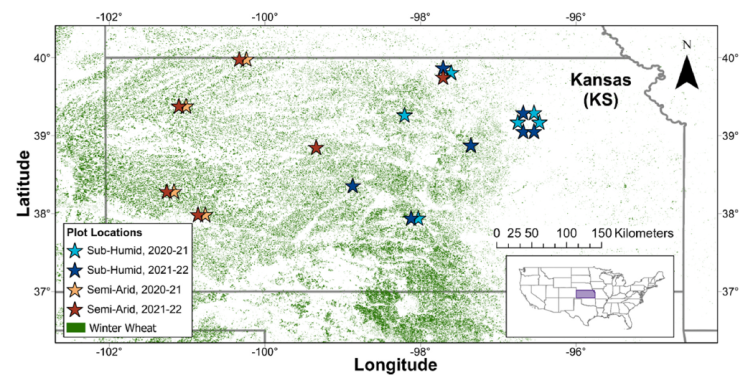
Fig. 1. Winter wheat area (green raster) and experimental sites and years included in this study. Inset map shows location of the study region within the continental US. (For interpretation of the references to color in this figure legend, the reader is referred to the Web version of this article.)
Management packages varied by practices producers can adjust, including seeding rate, fertilizer rates, seed treatment, split nitrogen applications, fungicides and micronutrients. Researchers also accounted for differences between central Kansas and the more semi-arid western portion of the state.
But the research did not end when the combine crossed the plots.
Researchers measured grain yield, protein and crop residue before samples were milled and evaluated for flour yield and dough characteristics. The flour was then baked into bread using standardized procedures.
Finally, researchers conducted a life cycle assessment that considered the resources consumed and emissions associated with the journey from agricultural inputs and wheat production through grain transportation, milling, flour transportation, baking, retailing and transportation to the consumer’s home.
“We see an increasing interest from different industry partners in quantifying the environmental footprint of wheat produced, with particular interest in Kansas”, said Romulo Lollato, the leader of the study. “We demonstrated here that both goals of producing more food and being environmentally conscious can go together. Since yield drives profit in our wheat operations, hopefully we see these results further translated into grower profit as some of these programs add incentives for sustainable-grown wheat.”
That farm-to-table approach revealed an important relationship between productivity and environmental impact.
Moving from the average to high management level increased wheat grain yield by 27%, from 49 to 63 bushels per acre. Improved management also increased grain protein concentration. Together, greater grain yield and protein production translated into more bread per acre in about 31%.
Producing more wheat required additional inputs, meaning global warming potential and energy use increased on a per-acre basis. But the increase looked different when researchers considered how much grain and bread those inputs produced.
From average to high management, global warming potential across the entire bread system increased in less than 4% per unit of bread produced (only from approximately 1.04 to 1.08 kilograms of carbon dioxide equivalent per kilogram of bread produced). In other words, higher management intensity produced considerably more food without a proportional increase in environmental impact per unit of bread.
The results suggest that reducing inputs alone is not necessarily the answer for better environmental outcomes. Instead, the research points toward efficiently using inputs to increase productivity and quality while practically maintaining the crop’s footprint.
Nitrogen management is one of the clearest opportunities.
Nitrogen was the largest driver of global warming potential and energy input differences during wheat production, accounting for 48% to 68% of greenhouse gas emissions associated with the wheat production phase as management intensified. Meanwhile, the impact of diesel, seed and pesticides declined on a per-unit-of-grain basis as productivity increased.
The study also showed there can be a point of diminishing returns. Bread yield did not increase from the high to top management level, leading researchers to focus their analysis on the transition from average management to a high level they considered a reasonable degree of intensification.
For producers, that confirms the value of matching management and inputs to realistic yield potential rather than simply maximizing inputs.
The research also puts the farmer’s role within the larger food system into perspective.
Wheat production accounted for approximately 9% to 18% of greenhouse gas emissions through the bread supply chain evaluated in the study. Baking accounted for 44% to 49%, while transportation represented another 29% to 33%.
That means improving wheat production is one part of a much larger effort. From the farmer who grows the crop to the companies that transport, mill and bake it, each link in the chain has an opportunity to improve how efficiently food gets to consumers.
“We were not surprised with nitrogen being the largest footprint of the wheat production cycle; what really surprised us was the fact that the production system really only accounted for less than 20% of the total footprint of the bread,” said Lollato. “This is an example on how collaborations across the value chain can be valuable in attaining a more sustainable product.”
For Kansas wheat farmers, the study also demonstrates another link in that chain: investing checkoff dollars in research that starts with real-world Kansas production practices, subjects them using rigorous testing and returns information producers can use to make management decisions.
The result is research that measures more than bushels. It follows those bushels all the way to the loaf, helping answer how Kansas farmers can continue producing the calories and nutrition consumers depend on while using resources as effectively and sustainably as possible.